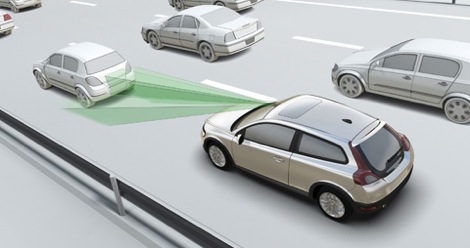
It sounds like a sci-fi fantasy – cars that can’t crash! But the fictional notion is about to become reality thanks to new technologies being fitted to vehicles driven in Britain – that in time could save more than 125,000 injuries each year.
Low speed shunts and collisions make up no less than 75 percent of all motor accidents. So, collision avoidance systems seem to represent the future of accident and injury reduction on UK roads and Thatcham has been evaluating three different systems:
The Volvo City Safety – which will be fitted as standard to their XC60 which will be on sale from November is the first system being tested. The system is active at up to 20 mph. It uses a form of laser radar (LIDAR) mounted in top of the windscreen. It is programmed to respond if the vehicle in front is either at a standstill or is moving in the same direction as the car itself. The brakes are pre-charged and should a collision be imminent it applies them and cuts the throttle. If the car is travelling below 10mph it should prevent the collision entirely and at a speed of up to 20 mph will reduce the impact by 50%.
The second tested system is the Mercedes Distronic Plus currently available on some S-class models. It uses two radar systems linked to the car’s cruise control system to maintain a safe distance between you and the car in front. It provides a continual calculation of the distance between the vehicle in front and the speed differential between them and will bring the car to a complete stop if necessary.
The third system is the Honda CMBS currently available on the CR-V. It is a radar system that again calculates the distance and the speed differential with the vehicle in front. Should this become out of kilter the driver receives visual and audible warnings before brakes are progressively activated. Seat belts are also tightened to alert the driver of an impending problem and lessen any resulting injuries.
Matthew Avery, Thatcham Research Manager said “All three systems offer enhanced protection – the Volvo in particular impressed because of its autonomous operation and the fact that it intervened at the last second and can completely avoid a crash.” However Avery reminds us the basics of driving: “It is imperative that driver vigilance is not lowered by the inclusion of such systems in their vehicles. These systems should not allow the driver to compensate – and take additional risks. The car is not the driver – the driver drives the car.”
Leave a Reply