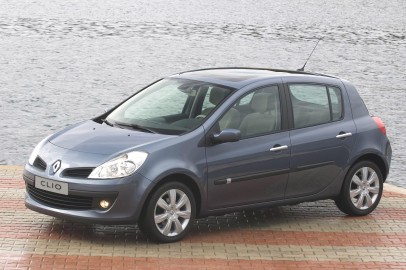
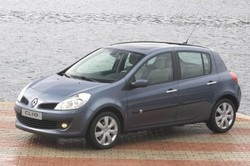
 After 7 years and 4.5 millions copies built, the Clio II gives way to the Clio III. Developed in 28 months only, the Clio III takes up the B-platform already used on the Renault Modus and Logan as well as the Nissan Micra and Cube. In the Clio III programme, Renault has spent €953 million among which 630 were committed to production–related investment.
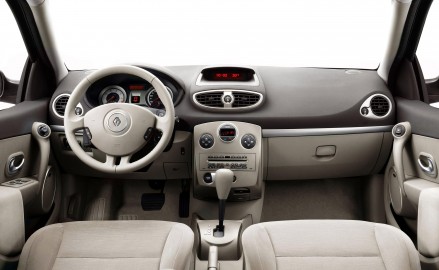
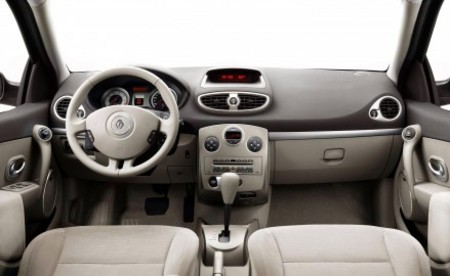
Renault has not taken any risk when drawing the Clio III. It’s a nicely balanced small car, sharply contrasting with the audacious Mégane II, from which it borrows the rear suspension scheme. In the cockpit, there are more references to the Mégane, such as the door handles and dials. Accommodation is claimed to be noticeably improved – shoulderoom is now 138cm – and so is the boot capacity, raised to 288 litres, or 1,038 litres when the rear bench is totally folded. However, contrary to that of the Yaris, the bench can’t slide. These values remain just average though, for a 5-door Punto’s boot has a capacity of 297 litres for example.
The equipment has not been left aside: hands-free card, automatic air-con, panoramic electric sunroof, Carminat Guidance System, rain and light sensors, cruise control with speed limiter and parking assist with reversing radar are standard or optional.
If Renault managed to improve roominess, it’s because passing from second to third generation, the Clio has been sized up. With a length of 399cm, a width of 170cm and a wheelbase of 257mm, the Clio is now the biggest in its class. But it might not last too long for the oncoming Punto III, Corsa and 207 will follow the same trend. This increase has a counterpart: the Clio III weighs 1,090kgs at least, with a peak at 1,210kgs for the 5-door 1.5 dCi. Besides, with a 0.72cdA drag, aerodynamics is quite poor. Rigidity and safety should nevertheless benefit from this increase, Renault targetting a 5-star EuroNcap rating.
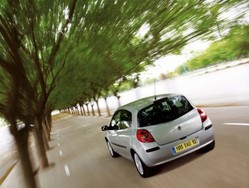 What about the engines? They remain quite unchanged, except for the 2.0. There’s a choice of 3 petrol and 1 diesel units, available in 3 versions.
Let’s take a look at the petrol engines range: 75bhp 1.2 litre 16V , 98bhp 1.4 litre 16V and 111bhp 1.6 litre 16V (or 88bhp in certain countries) units are available. Renault did not upgrade them as much as one might have expected.
There’s just one Diesel block, the 1.5 dCi, available in 3 levels of power : 68, 85 and 106bhp. Why not a 120bhp 1.9 engine?
These engines are fitted with either a 5-speed or a 6-speed manual gearbox (1.5 dCi 106). There are 2 optional automatic gearboxes: a robotized 5-speed one (with wheel mounted paddles) available on the 1.2 and the 1.5 dCi 85 and, oddly enough, an outdated 4-speed proactive hydraulic one on the 1.6.
Top speeds vary from 101 (1.5 dC1 68 version) to 118mph (1.6 111 and 1.5dCi 106 versions) and overall consumptions from 52mpg (1.5 dCi 68) to 32mpg (1.6 Proactive). None of these figures are exceptionnal, because of the weight.
Later, in 2006, a 2.0 engine will be released, delivering either 140 or, presumably, 180bhp in a turbocharged version.
If the Clio II handled superbly, we can expect the Clio III to be better still, for it comes with an upgraded ESP system including an understeer control.
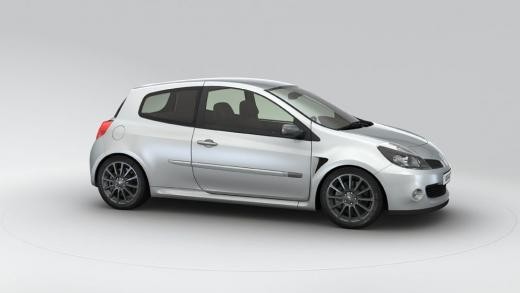
Like its predecessor, the Clio III comes in 6 trim and 3 equipment levels: Authentique, Expression, Dynamique, Privilège, Initiale and Renault Sport. Prices will be revealed in the next 3 months, but we can expect them to rise. A good time to bargain a Clio II which remains an excellent value.


 Having a factory in China is an obligation if you want to be considered as serious by Chinese car dealers and customers. Renault currently sells four models — Scenic, Megane, Vel Satis and Laguna — in the Middle Kingdom but 740 vehicles found an owner last year. In the middle of last year, Renault teamed up with Dongfeng, which produces the old ZX, the Xsara, Picasso and the 307 in a joint venture with PSA.