
Category: Uncategorized

  • Roewe 450 at the next Frankfurt motor show?

    Roewe 450 at the next Frankfurt motor show?

    Roewe450jpg_jpeg_image_500x375_pixe
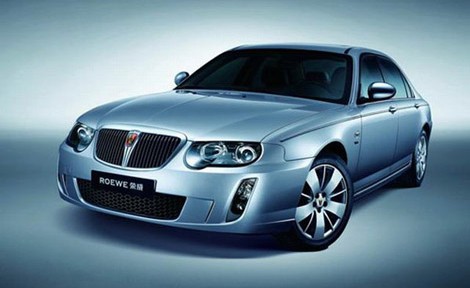
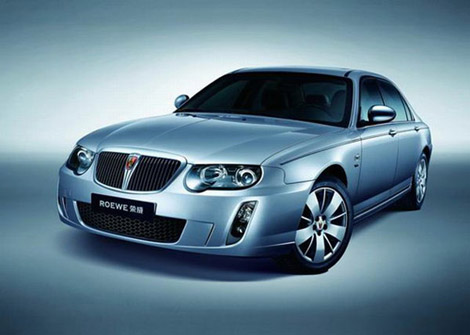
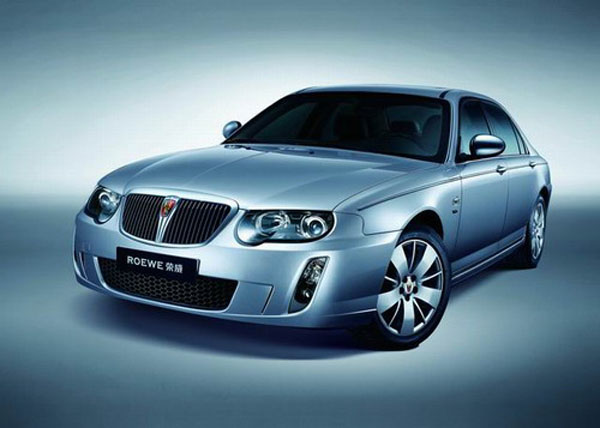
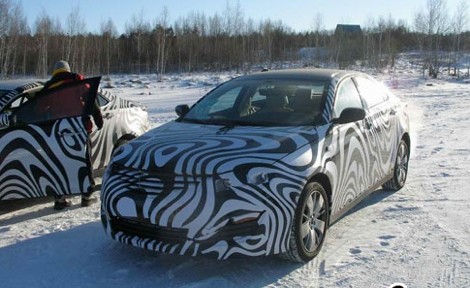
    According to insiders, SAIC may unveil the Roewe W2/450 at the next Frankfurt motor show. What better way for the Chinese carmaker to prove how much importance they attach to the European market? The car was originally expected to be launched at the Shanghai motor show in 2008. (so is it frankfurt or shanghai? bit confused…)

    Revealing the car at Frankfurt will surely be symbolic for the Chinese automotive industry. Until now, the Chinese cars displayed at other European motor shows have not met with a favourable reception from European customers. They instead been met with amusement. With the Roewe W2/450, the reaction could be fear and stress as the first information looks promising.

    The compact saloon will be dubbed 450, since the upper model is called 750 and the lower model 250. It will be available with a choice of a 1.6-litre petrol, a 1.8-litre petrol or a turbocharged 1.8-litre petrol. According to insiders the power will range from 80 bhp to 120 bhp. Expect more power for the turbocharged 1.8-litre engine. A V6 version could also be a good choice on European markets in order to build a brand image. Of course, it means that Roewe can install the KV6 engine in the W2/450 model.
  • Gordon Murray and his latest project

    Gordon Murray and his latest project

    Gordon_murray_design_2
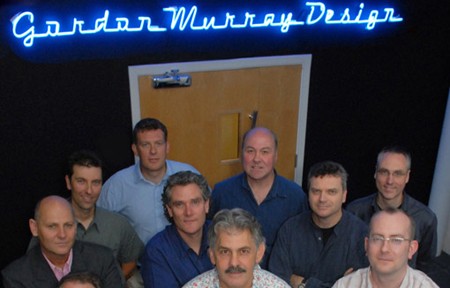
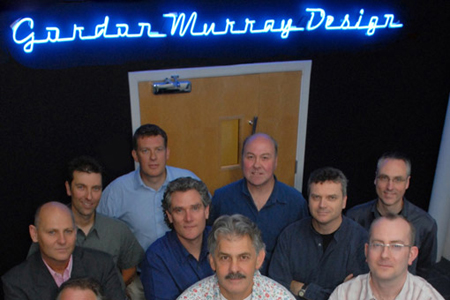
    Having just set up his own company, Gordon Murray Design, the eponomous designer has already given some information regarding his latest project. It is well known that the engineer has been working on a new city car for the past decade. During the launch party for his new design company, the British magazine Car was able to gather more information about the long-awaited car.

    Dubbed T25, the car will be a “a new class of vehicle“ according to Murray. Instead of using the engine and the platform as the starting point for the car’s design, the engineer started with an obsessive and constraining goal: the smallest carbon footprint possible.

    The car will use less resources at every stage from its production to its scrapping. Thanks to lightweight materials, the car will be economical to run and to buy. Expect a price tag of about £5,000/€7,400/$10,000.

    The car will not be sold under the Gordon Murray badge. The engineer will license the concept to any carmaker that wants to build the car. The latter will have the freedom to rebrand it and to install any engine under the bonnet. At a time where developing engines requires a large amount of money due to stronger regulations, Gordon Murray made the right choice. He and his team will be able to focus on what the South African engineer does best: light and efficient cars.

    Source: Car

  • Bristol presses stolen

    Bristol presses stolen

    Bristolblenheim3_image2jpg_jpeg_ima
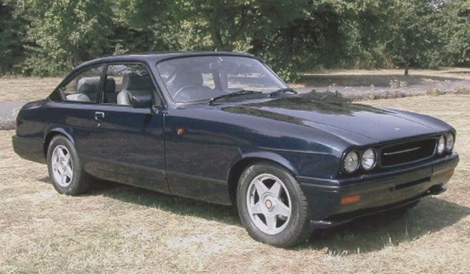
    The legendary British carmaker Bristol had the unpleasant surprise last Monday when it discovered that thieves had broken into its factory and, rather than stealing the cars, had stolen the company’s presses. The presses were used to build body panels for the Blenheim coupes.

    Thanks to its low volume production of about 150 cars per year, Bristol has enough body panels for the coming months. Executives are nonetheless expecting a slowdown in the future.

    Bristol is a new victim in the metal madness where scrap prices are motivating thieves. Since 2005, metal prices have risen by 95% according to Barclay’s base metals index. AT&T has lost £1.5 Million in copper wiring to thieves since January. In 2006 more than 24,000 manhole covers were stolen from the streets of Shanghai.

  • Roewe builds 10,000th Chinese KV6

    Roewe builds 10,000th Chinese KV6

    Roewe750_2
    The first awarded Chinese engine, the Roewe KV6, has been producced at 10,000 units since the end of January. For this occasion the Chinese invited the press at a party and announced it would produce 80,000 KV6 in its Bo Shan factory in 2007.

    Roewe750_01
    Launched in February, the 750 model is a big success thanks to a big advertsing campaign. In order to get one, the buyer must drop a deposit whose amount varies from 5% to 25% of the price tag and must be ready to wait from one one month to three months.

    Recently, the 750 model got a good review from the British car magazine Auto Express and we can expect it to be sold in Europe in 2008.

  • Lesson: how to build a W16

    Lesson: how to build a W16

    W16build_2
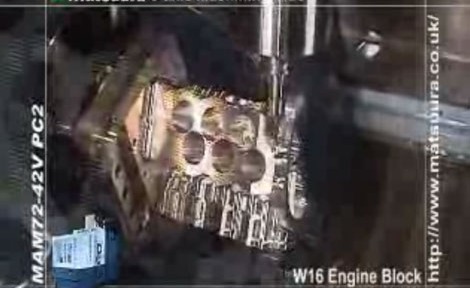
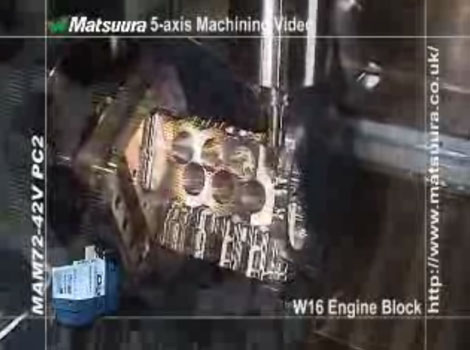
    We often talk about power, torque but sometimes watching this video is more impressive than all figures.

  • Daihatsu Esse : forbidden for men

    Daihatsu Esse : forbidden for men

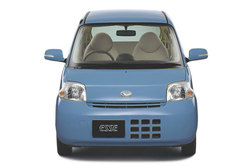
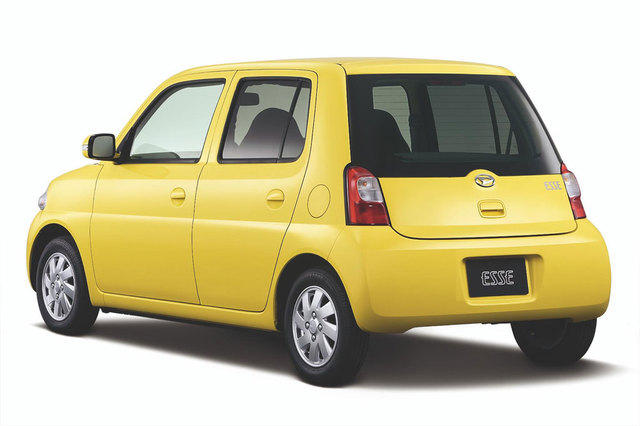
    Esse_blueUnveiled at the Tokyo Motor Show, the new Esse from Daihatsu is being sold in Japan from today. Its name, an acronym for Economic, Simple, Smart and Easy summarizes the characteristics of this new kei-car. In Japan, kei-car is a particular segment which allows the owner to get some tax and insurance relief and most importantly an exemption from the usual requirement for a parking space certification.

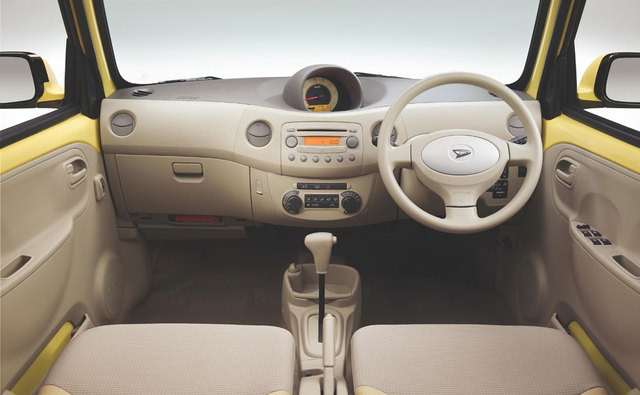
    Esse_cockpitSo, the Esse is 3.39 m long, 1.48 m wide and offers enough space for four tiny Japanese girls and their bags in the small boot. Daihatsu engineers have been very clever in designing a car with poor features which doesn’t feel like it, thanks to fresh colours as Renault did with the Twingo in 1992. The plastics and seats share the same colour as the exterior painting. Like the Twingo, the instrument panel is central but the dashboard is less nifty and closer to the layout we can find in any Japanese car.

    In order to meet the regulations, the Esse is powered with a small 600 cc 3-cylinder engine with an output of 58 bhp at 7,200 rpm. Coupled with a CVT automatic gearbox, it is set to become the perfect choice for girls who don’t want to spend a lot on a car.

    Esse_rearstyling

    Esse_seat

  • V12 for Connaught

    V12 for Connaught

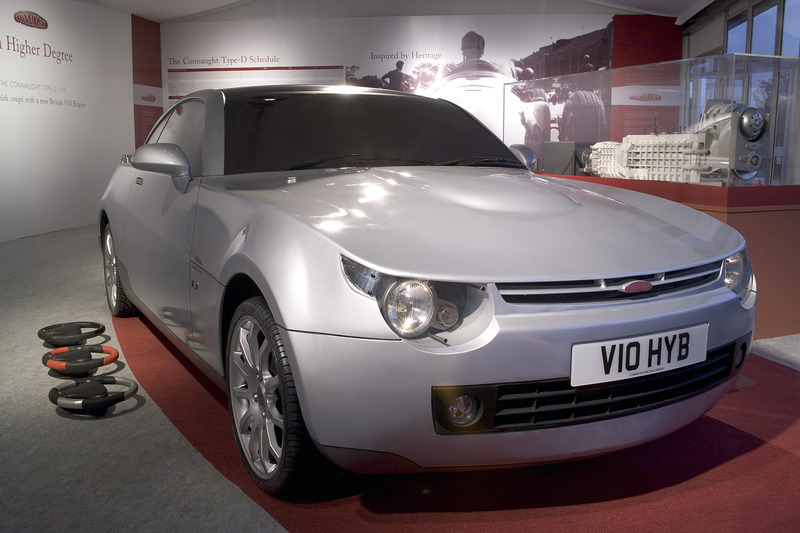
    Connaught03 If the United Kingdom has no carmakers, the country is at least full of dedicated craftsmen, who spend their lives designing and producing handmade cars. Even if life is harder since the EU passed stricter safety laws, there is a crop of new companies every year. This year the most important and original one is Connaught. Some craftsmen – such as Morgan – have produced the same car since the 1930s.

    Some companies – such as Noble – spend their time producing the best sports cars. Connaught chose to produce a sports car with an original V10 2 litre engine. Since the car was released to the press, engineers have gone back to work, done a feasibility study on the platform and concluded it was possible to stretch it by 4 inches. For Connaught, it’s an opportunity to build a new model. Connaught plans to launch a new sedan in 2010 which would be equipped with a V12. This V12 would be given a supercharger to develop 360 bhp.

    Source: Autocar

  • Automotive atrocities : Bond Bug

    Automotive atrocities : Bond Bug

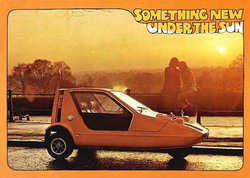
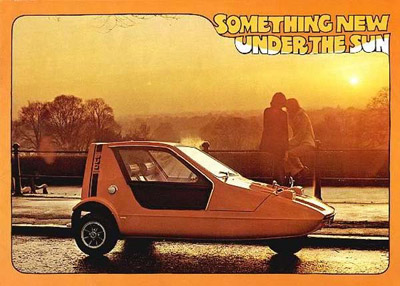
    Bondbugbrochure1_1The Bond Bug could be the automobile equivalent of Cheddar.  It is the colour of Cheddar, it resembles a car just like Cheddar resembles cheese, but its three wheels make you doubt it from the start just like the initial tasting of Cheddar makes you regret the experiment.

    The Bug is the fruit of a team of men who aim to marry the best of two car manufacturers. On my left, the British manufacturer Bond with the heterogeneous catalogue which ranged from the jet ski to the three wheeled car while also including 2 litres coupes with the evocative name of "Bombshell". Bondbugbrochure3On my right the other British craftsman of the three wheeled car, Reliant, which purchased the first one in 1969. The power taken by Reliant predicted the worst and the inconceivable happened.  In a stroke of genius, they decided to design a three wheeled car in the spirit of the late Bombshell coupes. In order to be ‘hip’, they asked the famous Ogle studio to design the new car, and the studio did its best to draw an inimitable car.

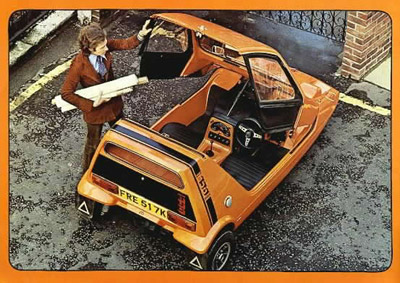
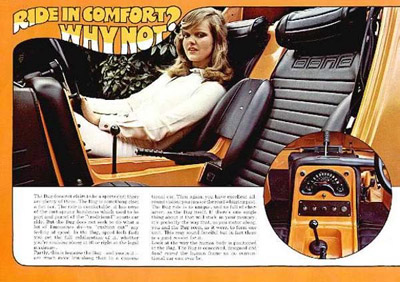
    The distinguishing feature of the Bug was that it was available in a single colour, orange, which enhanced a slender shape where aesthetic research and economy dominated: the originally retractable headlights for aesthetic concerns became fixed for accounting concerns; the cockpit opened completely conferring on all drives a space mission ambiance while the doors were out of plastic to reduce the cost; finally, the optional black stripes on the side pillars conferring on Bug its sporting character completed the piece of work.

    Bondbugbrochure2All this work with an unanticipated result was nothing compared with handling of the Bug. The problem was that this bug was lighter than an insect and the addition of the driver in the equation transformed the handling in an amusing way.  Numbers of driver tried to improve this by installing a sand bag in the trunk, but the operation caused the unexpected effect of the front wheel lifting off the ground. With those inimitable qualities and a high price, one will understand well that the Bug had some difficulties in meeting with success, something which surprised the optimistic managers who had built more than 350 units in anticipation. This failure announced the end for Bond, but not for Bug, which continued its career at Reliant and found nearly 2 500 owners during its five years of production.

  • Automotive atrocities : AMC Pacer

    Automotive atrocities : AMC Pacer

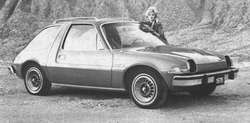
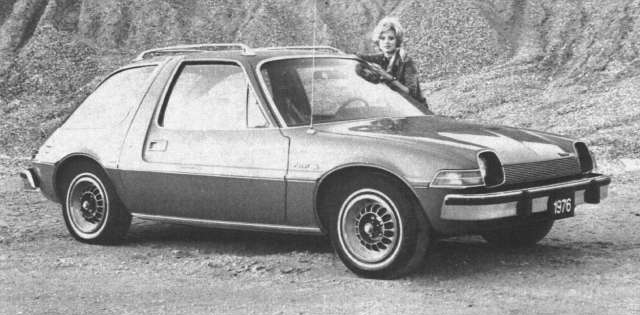
    Pacdl76_2AMC Pacer is the iconic car of the 70s, which defines the era even more than a Bee Gees track or the Farrah Fawcet hairstyle. In fact, dressing as Farrah Fawcet and listening to a Bee Gees track while driving a Pacer with wood panels to go to your job was perhaps the ultimate 70s experience.

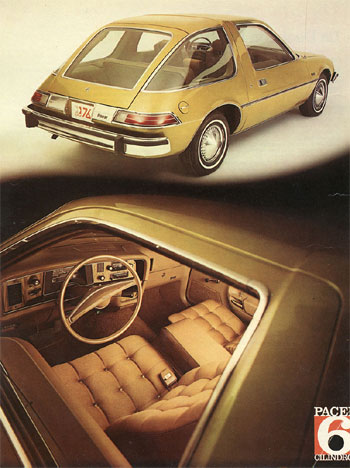
    Pacer76y_2AMC had intended great things for the Pacer. It was supposed to have been powered by a small rotary engine rather than a conventional, heavy, fuel-thirsty piston engine tied into a compact front wheel drive to save weight and allow for the maximization of interior space. The whole car was built around this idea. But AMC made the mistake of trusting General Motors to supply the rotary engine. At the last minute General Motors abruptly dropped the intended rotary engine and what was to have been the heart of the car was replaced by an in-line six engine that dated to the 50s. As a result the only thing modern or innovative about the car when it hit the showroom was its original bodywork. Unusually, the passenger side door was four inches longer than the driver’s side door. Nearly 40 percent of the Pacer’s exterior surface was glass. This was a good idea for great visibility, but also let the sun bake the interior to infernal temperatures that caused early fissures and cracks in the dashboard and even with the expensive air conditioner option, the interior was not livable on summer days.
    Pacwg78_1Talking about an economic car is a heresy because the old in-line six with 90 HP had a hard life with the 3,500-pound Pacer. With great generosity, AMC provided a sporty option that delivered 95 HP. Later, the Pacer was equipped with no more than 125 horsepower thanks to a V8. Due to poor sales, AMC introduced a wagon but only 1,341 coupes and 305 wagons were sold the last year in 1980. Iconic car of the 70s, the Pacer is a symbol of the American automotive industry’s utter confusion in the face of new changes and competition from the Japanese.