Category: Industry News

  • IHI to build the smallest turbocharger in the world

    IHI to build the smallest turbocharger in the world

    Turbo
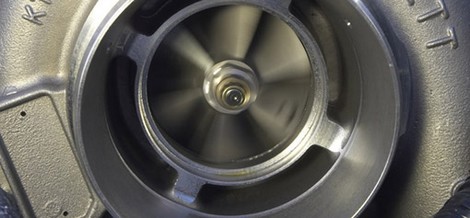
    Japanese IHI has announced that it has developed the world’s smallest turbocharger for use in cars.

    The turbocharger is about 20% smaller than existing units. Smaller turbochargers have the advantage of eliminating the famous ‘turbo lag’ which is the delay between pushing on the accelerator pedal and feeling the turbo kick-in.

    The turbocharger will be featured in future Daihatsu Kei car whose engine displacement is limited by law to 660cm3.

    In Europe IHI provides turbochargers to BMW and Mercedes.

  • More information on the Sintesi Concept by Pininfarina

    More information on the Sintesi Concept by Pininfarina

    2008_pininfarina_sintesi_01
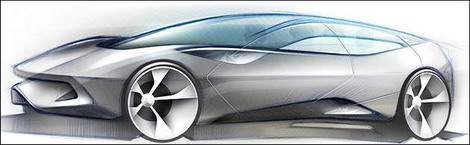
    As reported in a previous post, Pininfarina will unveil a concept car called Sintesi Concept at the Geneva Motor Show in March. Until now, details remained scarce but information is emerging as we’re getting closer to the show.

    The Sintesi Concept will take its inspiration from the Birdcage 75th and the Nido as Pininfarina wants the concept to be a perfect combination of sportiness and functionality. The Nido was a city car while the Birdcage remains one of the greatest Pininfarina ever.

    “Three years ago we unveiled Birdcage 75th, our last prototype. Together with our new concept Sintesi we would like to anticipate new car design trends” says Andrea Pininfarina, Chairman and CEO Pininfarina S.p.A.

    “This concept car is the synthesis of our values, of the love for our work and our passion for innovation, of beauty driven by functionality, of sportiness and elegance. However, Sintesi isn’t only the expression of Pininfarina design; it also embraces innovative technologies that allow us to explore new typologies of mobility, active safety and packaging solutions” states Lowie Vermeersch.

    The concept car will feature fuel cell and batteries which will be placed in an innovative way, around the vehicle instead of being grouped under the boot

  • AvoVaz might cancel its contarct with Magna

    AvoVaz might cancel its contarct with Magna

    Vazladacsoncept2007hatchback1486393
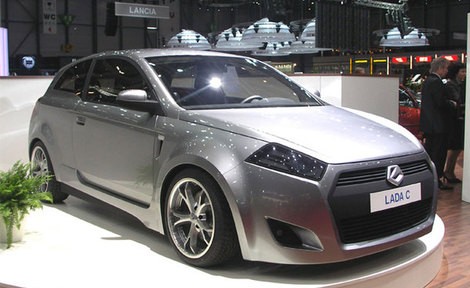
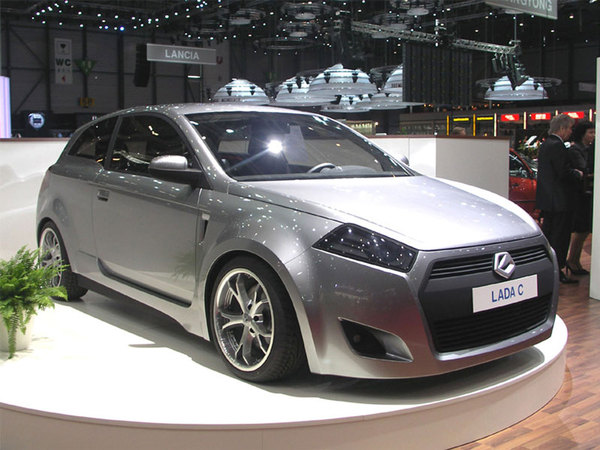
    AvtoVAZ might cancel its agreement with the Canadian Magna as Renault bought a 25% stake in the Russian car maker.

    The Russian newspaper Vedemosti has suggested that AvtoVaz might cancel its contract signed before the Renault agreement. The contract aimed at modernizing the company’s facilities. Accoridn to insiders, the French car maker has proposed alternative plans.

    With AvtoVaz, Magna had a foot in Russia which might soon become the first European market. If Magna loses the AvtoVaz contract, it will still own a large part of the holding which controls GAZ and the van maker LDV.

  • Tesla delivered its first car

    Tesla delivered its first car

    Tesladelivery
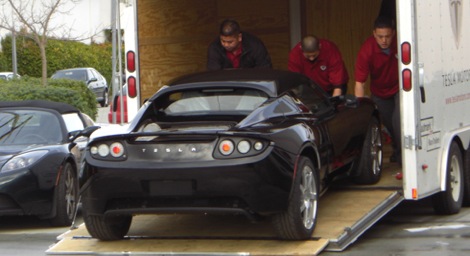
    Tesla delivered its first production car on Friday to the company’s chairman, Elon Musk.

    Despite the encountered difficulties, the start up finally succeeded in reaching the production stage which remains a bit complicated. The car was flown from England where the car is built at the Lotus manufacturing plant in Hethel while the batteries were imported from Tesla’s plant located in Thailand. Both parts were assembled at the company’s headquarters before being delivered to Elon Musk.

    Tesla chairman called the moment “the beginning of the beginning”. In the meantime, he confirmed the first deliveries will start in mid-March. The first cars will be delivered with a temporary transmission before getting letter the final version of the single-speed transmission.

    The second car will be delivered to Martin Eberhard who left the company at the end of November.

  • Spanish car market in the doldrums

    Spanish car market in the doldrums

    M30signs
    The registration of passenger cars in January decreased by 12.7% over the same period last year, reaching a volume of 101,630 vehicles. This decrease has two basic reasons.

    The first is “cyclical” generated by the advancement of operations for the purchase of vehicles from the highest segments, which occurred in December, as a result of changing tax levied from January 1 this year with a tax rate exceeding vehicles emitting more CO2.

    The second cause is more “structural” and responds to a decline in private consumption and the overall performance of the economy.

    The evolution of demand from individuals and companies in January showed a decrease of 16.2% while buying rental market increased by 39.6% over the same period.

  • BMW to overtake Mercedes in India by 2009

    BMW to overtake Mercedes in India by 2009

    X5_india_01
    BMW wants to overtake Mercedes on the fast growing Indian luxury car market in the coming few years. “As we get closer to Mercedes, you can imagine we have in our sight that we want to overtake Mercedes, whether we do it in 2009 or 2010 we will have to see,” said BMW Director Region Asia Pacific David Panton.

    Last year, the German car maker sold 1,387 vehicles while it planned to sell 1,000 units. In india since the mid 90’s, Mercedes sold last year 2,491 cars. This year BMW plans to sell 2,000 vehicles built in its factory located in Chennai. Mercedes expects to deliver 3,000 vehicles this year.

    David Panton said the Indian customers have accepted the BMW as a luxury brand and he considers the Indian market to be more stable and reliable than the Chinese market.

    BMW has invested £15 million in the Chennai factory and plans to open a design center which will give the company the ability of better customization for the emerging market. BMW may also outsource a portion of Rolls Royce design and R&D to India.

  • Revamped Romanian first registration car tax to hurt Dacia

    Revamped Romanian first registration car tax to hurt Dacia

    7690_hd_ren2004dacialogan
    Dacia deputy chairman, Constantin Stroe, is fighting the Romanian government and the EU over the method used to calculate first registration tax. As a result of the future car tax, he is expecting the growth of the Romanian market to slow in 2008 and therefore foresees personnel cuts at Dacia.

    The Romanian government is currently handling talks with the European Union over the calculation method used for first registration tax. The tax was introduced as a means for the government to stop the inflow of used cars onto the Romanian market expected when the country joined the European Union last year. However, the EU pointed out that the tax is discriminatory and decided to start procedures regarding the infringement of the European Union Treaty.

    The Romanian government made some modifications to the calculation method in April 2007. According to these modifications the amount of the tax will fall with the growth of the age of the car, but European Union experts still considered the tax to be discriminatory, especially in regard to the taxation of imported and domestic second-hand cars. Last November, the European Union launched the second stage of the infringement procedure and Romania now has two months to comply with EU requirements.

    The current tax is applied the first time a car – either new or used – is registered in Romania. The amount levied is calculated based on the car’s age, engine capacity and emission output. Older, more polluting cars pay more. In the final variant due to be established at the end of January, the registration tax will be reduced by half for non-Euro vehicles over 20 years old, with a capacity of 1,600ccm, while for a car of 3001ccm, 15-16 years old, the tax will be reduced over three times. The tax remains unchanged for new Euro 4 compliant vehicles with a capacity of between 1,400 and 3,000ccm.

    Dacia is likely to be damaged by the revamped tax as it holds a market share of around 30% on the Romanian market. According to Dacia vice president Constantin Stroe, the tripling of the tax imposed on new cars and the decrease by up to ten times on taxes on non-Euro compliant cars may leave the doors of the Romanian market wide open to all the non-functional cars in Europe. He said in an interview for BBC that the number of old cars arriving in Romania after the new tax comes into force may reach 500,000 units, compared to 125,000 in 2007.

    This year, Automobile Dacia will hire 3,000 people at its assembly plant and 600 university graduates in its administrative departments in order to hit its production target of 400,000 cars in 2009. Should the tax be adopted and Dacia sales go down, the number of new employees will shrink in the following years.
  • Peugeot-Citroen to build a factory in Russia

    Peugeot-Citroen to build a factory in Russia

    P06182002
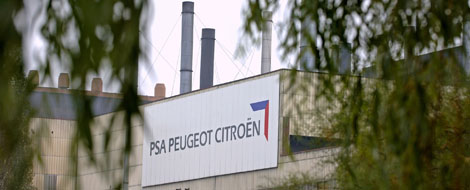
    Peugeot-Citroen has signed a contract with the Kaluga region’s government to build a factory which will produce 75,000 cars a year in 2010.

    The future factory will produce the Peugeot 207 and the Citroen C4 models. The company will invest £223 million for the construction of the plant and will create 2,600 jobs.

    The French group will join other car makers in the area such as Volkswagen and Mitsubishi. Due to be finished in 2009, the Volkswagen factory will produce the Passat, Touareg and Polo models at 115,000 units per year. Mitsubishi has also announced its intent to build an assembly plan in Kaluga with the initial annual production capacity of 50,000 cars.

  • Lutz compared tthe Volt to the moon shot

    Lutz compared tthe Volt to the moon shot

    Naiascadillac02
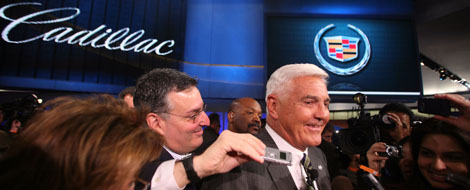
    In an interview with Wired, the tanned straight talker Bob Lutz likened the Chevrolet Volt project to the moon shot that happened almost forty years ago.

    Due to be unveiled in November 2010, the Chevrolet Volt will be the first plug-in hybrid in the world but its development is not without stumbling blocks. Indeed, engineers struggle with aerodynamics and battery technologies. However, GM’s VP for Global Program Management John Lauckner declared that latest battery prototypes were “very encouraging.” Regarding the aerodynamics problems, Bob Lutz said that they had been resolved thanks to the new design.

    Nevertheless, some observers remain sceptical concerning the announced launch date. GM’s engineers have less than three years to solve current problems as well as the likely future difficulties involved in the production of such a new vehicle. The success of the future car also remains in doubt as Bob Lutz has recognized that the announced price of $30,000/£15,200 won’t be achievable. The first Chevrolet Volt may come closer to $40,000/£20,250. Indeed, the usual cost minimization won’t be made due to the close launch date.

  • BMW plans to sell 400,000 cars in the U.S. in the future

    BMW plans to sell 400,000 cars in the U.S. in the future

    P0041013
    BMW wants to increase its sales on the American market from 336,000 units last year to 400,000 vehicles per year in the medium term. The German car maker plans to introduce new models in order to expand its lineup. The new X6 officially unveiled at Detroit will be the first SUV coupé to be introduced in the U.S. this year.

    BMW’s head of sales and marketing, Stefan Krause said to Auto Motor und Sport that “Today Europe is still our main market with a share of around 60 percent followed by North America with 24 percent and Asia with 11 percent,” but “looking at countries, the United States with 336,000 units overtook Germany as our main market already a few years ago. And is there that we see the absolutely strongest growth worldwide.”